
One scene in Pedro Almódovar’s “Todo sobre mi madre” (All About My Mother) never fails to send shivers down my spine: At the culmination of the first act, Manuela (Cecilia Roth) ponders her return to Barcelona while aboard a high-speed train. Manuela fled to Madrid nearly two decades earlier while pregnant, and this marks her first journey back. As Manuela reflects on her past, the train speeds through a blurred tunnel, transitioning to a breathtaking nighttime helicopter shot of Barcelona, accompanied by the haunting harmonica of Ismael Lo’s “Tajabone.”
For me, this moment epitomizes Almódovar’s mastery of storytelling, where Barcelona itself becomes a character. In just 90 seconds, he creates a world about motherhood and new beginnings. It’s not hard to see the symbolism of Manuela’s metaphorical rebirth as she traverses the canal of a high-speed train. Concurrently, Barcelona has undergone its own transformation, mirroring Manuela’s journey: From a neglected, rundown city to a vibrant metropolis on the rise, symbolized by its resurgence following the 1992 Summer Olympics. If you’re yearning for cinematic escapism, “All About My Mother” is the ticket.
What captivates me about Almódovar’s work, particularly in this film, is his adept balance of absurdist escapades and heartfelt drama. As Roger Ebert eloquently put it in his review a quarter-century ago:
“Do you take it seriously, like the characters do, or do you notice the bright colors and flashy art decoration, the cheerful homages to Tennessee Williams and ‘All About Eve’ (1950) and see it as a parody?”
“All About My Mother” centers on Manuela, a hospital worker dealing with heart transplants, whose return to Barcelona after a family tragedy sets the stage for encounters with old friends like the transgender sex worker Agrado (Antonia San Juan). Manuela’s quest to find the father of her child intertwines with the stories of Sister Rosa (Penelope Cruz) and actress Huma Rojo (Marisa Paredes), whose turbulent relationship with her co-star Nina (Candela Pena) propels Manuela into the spotlight as Nina’s replacement in a play, with Agrado unexpectedly becoming Huma’s assistant.
This film marked a watershed moment for Almodóvar: His narrative threads, sometimes bordering on the absurd, now felt grounded in genuine emotional stakes. It also heralded a breakthrough with American audiences, earning Almódovar his first Oscar for Best Foreign Language Film and paving the way for wider recognition in subsequent years. Though he continues to craft thoughtful, cheeky, and undeniably beautiful films, for me, Almodóvar’s apex came at the turn of the millennium, with “All About My Mother” and its follow-up, “Talk to Her” (Hable con ella).
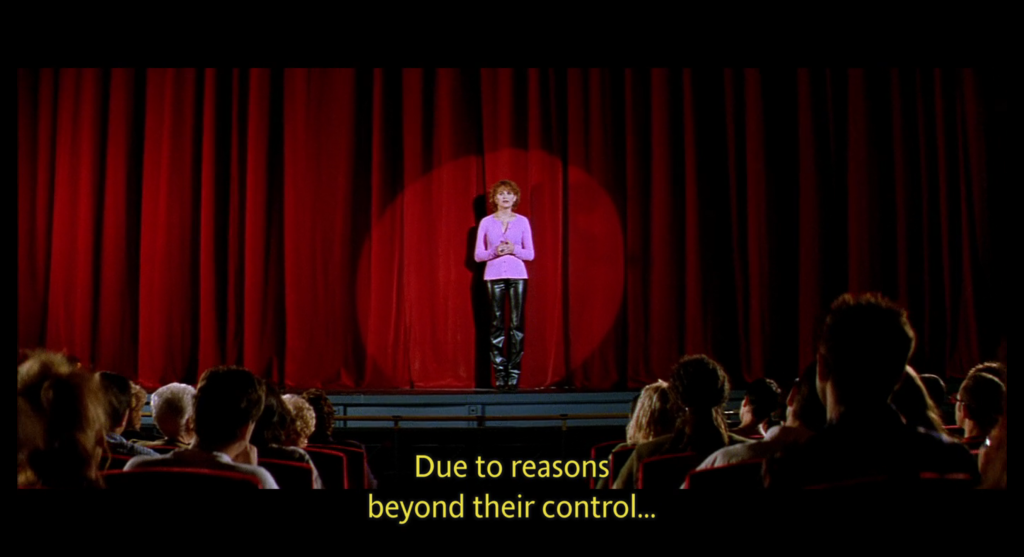
In addition to the Academy Award, the Spanish maestro and his ensemble cast racked up seven Goya Awards, Best Director at Cannes, and a plethora of other accolades. While his earlier works flirted with the absurd, “All About My Mother” pushes those boundaries further, borrowing elements from “All About Eve” and “A Streetcar Named Desire” while introducing its own outlandish twists, like a pregnant nun and a heroin-addled actress’s cancellation leading to an impromptu one-woman show by one of the first openly transgender woman in a major film.
Almodóvar’s daring exploration of gender and sexual fluidity in 1999, a time when LGBTQ+ representation was less prevalent, underscores his commitment to celebrating human complexity without diminishing differences. “All About My Mother” is inherently a tale of women and family; while male characters make fleeting appearances, it’s the women who take center stage, navigating a world where reliance on oneself and female bonds reign supreme, absent fathers, sons, or spouses. If ever there were a film that effortlessly defied the Bechdel test, “All About My Mother” is it.
As with any Almodóvar production, the film is anchored by its stellar cast—Roth, returning for her first Almodóvar venture since 1983’s “Dark Habits” (Entre tinieblas); Marisa Paredes, back after “The Flower of My Secret” (El flor de mi secreto); the magnetic Antonia San Juan as Agrado; and the debut of Penelope Cruz in an Almodóvar film. Spanish songwriter Joaquín Sabina, with his gravelly voice reminiscent of countless nights of revelry, even penned a song in 1992 aptly titled “Las chica de Almodóvar.”
What draws me back to “Todo sobre mi madre” time and again is multifaceted. Like any film worth revisiting, new details reveal themselves with each viewing. The meticulous set design, costumes, and cinematography hallmark this juncture in Almodóvar’s career; you wouldn’t have to see the credits or hear the dialogue to recognize who created this world. Likewise, the complexity of all the plot threads that weave together seem outrageous individually but eventually tie a tidy knot. There’s a slow burn here, with deeper investment in characters paying off unlike some of Almodóvar’s earlier works.
Nostalgia also colors my affection for the film. I openly tell people it’s my favorite movie in Spanish, and the best Spanish-language movie ever made. I can’t recall exactly when I first watched it, but it was sometime after I’d studied and worked in Madrid, and probably around when I was studying for the DELE exams. Since then, I’ve probably watched “All About My Mother” annually. For me, it stirs up memories of my time living in Madrid, the overwhelming experience of my first visit to Barcelona, and the time after when I looked back on both with fondness.
“All About My Mother” epitomizes the genius of a director honing his craft for nearly two decades. The convergence of experience, vitality, and opportunity birthed a film as audacious as it is poignant. It solidified my love for Spanish cinema and, years later, played a pivotal role in shaping the career path I ultimately chose.