Tardes de Soledad Review: Bullfighting, Beauty and Modern Spain
Every spring in Spain, the bullfighting posters go up.
They appear on kiosks and lampposts and the sides of bars, printed in a style that hasn’t meaningfully changed in about a century — the matador in full traje de luces, the bull mid-charge, the name of the plaza, the dates. In Seville, during the Feria de Abril, they go up everywhere. In Madrid, ahead of the San Isidro festival in May, the Las Ventas billboard dominates entire blocks. In smaller towns across Andalusia, a single corrida on a Saturday afternoon can feel like the most important thing happening in the province.
Both foreigners and Spaniard alike have to reconcile their feelings about bullfighting. Not in a moral sense, necessarily — or at least not right away — but practically. Bullfighting lives on in ways that might surprise non-Spaniards: It’s on the sports pages. It’s on regional television. It’s in the restaurants, the ceramics and the street names. Ignoring it requires active effort.
Tardes de Soledad (Afternoons of Solitude), Albert Serra’s 2024 documentary about the Peruvian bullfighter Andrés Roca Rey, captures the spirit of bullfighting without assigning an agenda. The film won the Golden Shell at the San Sebastián International Film Festival, took the 2026 Goya Award for Best Documentary, and was named the number one film of 2025 by Cahiers du Cinéma. At times beautiful, and other others difficult to watch, Tardes de Soledad will make you feel something. That’s sort of the point.
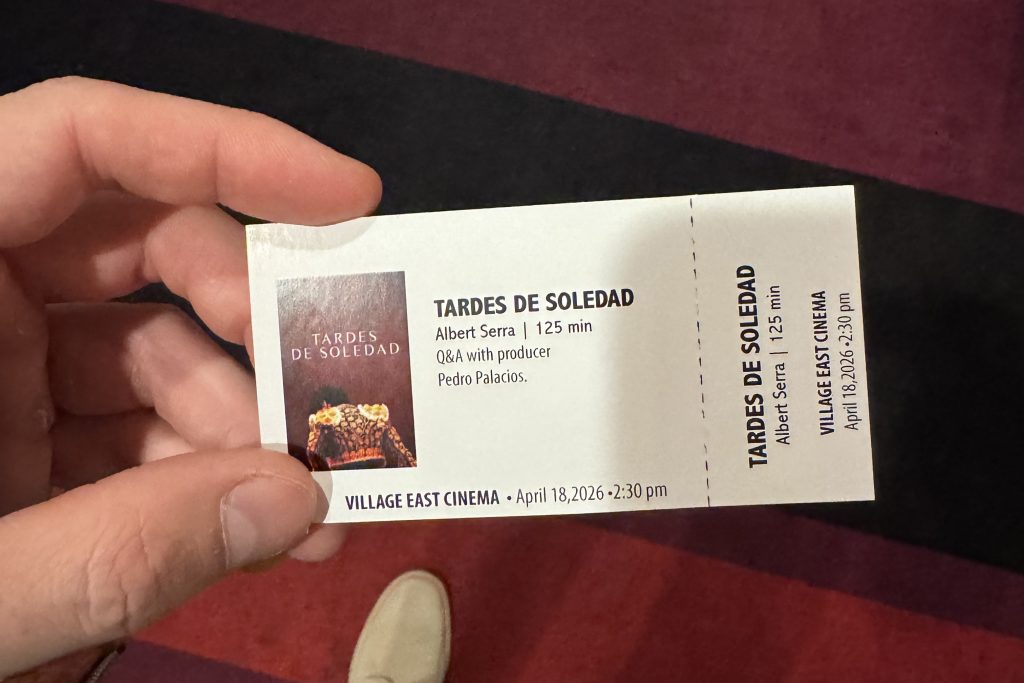
I was fortunate enough to see the film at the New Spanish Films festival in New York in April. And to bolster my bona fides: My graduate degree was in documentary production, so I’ll attempt to speak from both technical and narrative perspectives.
What is Tardes de Soledad?
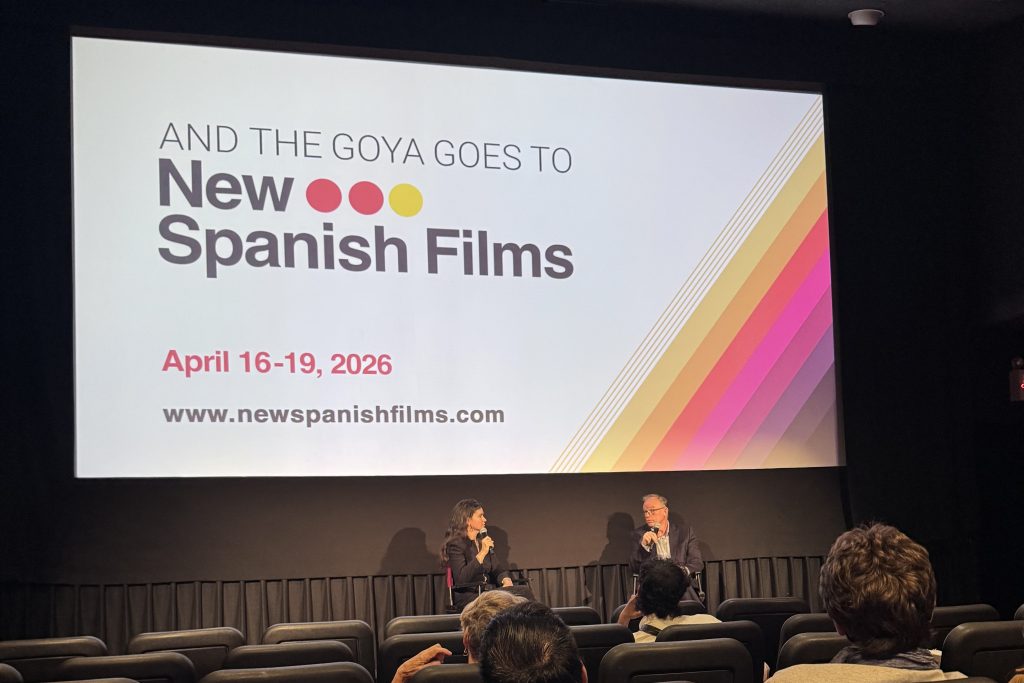
Serra spent 5 years on the film — three filming, two editing — following Roca Rey across 14 bullfights in Spain. According to producer Pedro Palacios, who did a Q&A session after the film, Serra recorded some 800 hours of footage.
Roca Rey, the assumed protagonist, creates plenty of tension simply by existing. The most celebrated matador working in Spain right now is Peruvian and not Spanish. At 27, his dashing looks would make fashion photographers grab their gear, and some aficionados consider him to be the best in the world at a sport — if you consider it one — that a significant portion of Spain wishes didn’t exist.
Strikingly, the film features no narration. No text on screen. No interviews. No talking-head experts explaining the cultural history or significance of bullfighting. Serra simply films: The ring, the bull, the kill, then the car ride to the next city, then the hotel room, then the ring again. This filmmaking style is called Direct Cinema, and it’s one of the more difficult documentary styles to execute.
The cinematographer, Artur Tort Pujol, shoots in extreme close-up — faces, hands, the embroidery on the costume, the bull’s flank — in the same way that the 2006 Zidane documentary by Douglas Gordon and Philippe Parreno followed its subject: Total immersion, no context, no crowd, no score. The widest shot in Tardes de Soledad happens in a hallway when the camera peers at an elevator door. That physical closeness creates a narrative closeness that the viewer might not realize until they take a mental step back once the film has dended.
The effect for Tardes de Soledad places it somewhere between a religious ritual and a fever dream. The New York Times called it “mesmeric not polemic.” The LA Times said: “It’s inhumane, it’s human, and it’s a hell of a film.”
Before the film had screened a single frame at San Sebastián, the animal rights party PACMA demanded it be pulled from the festival. Serra declined to engage with the debate, saying he’d approached the subject from “personal and aesthetic fascination” and had no interest in the sociological argument. The film went on to win the festival’s top prize.
It’s currently streaming on MUBI, where it will quietly rearrange your feelings about a subject you might not have known you had feelings about.
Is bullfighting dying in Spain?
Yes and no, which is Spain’s answer to many things.
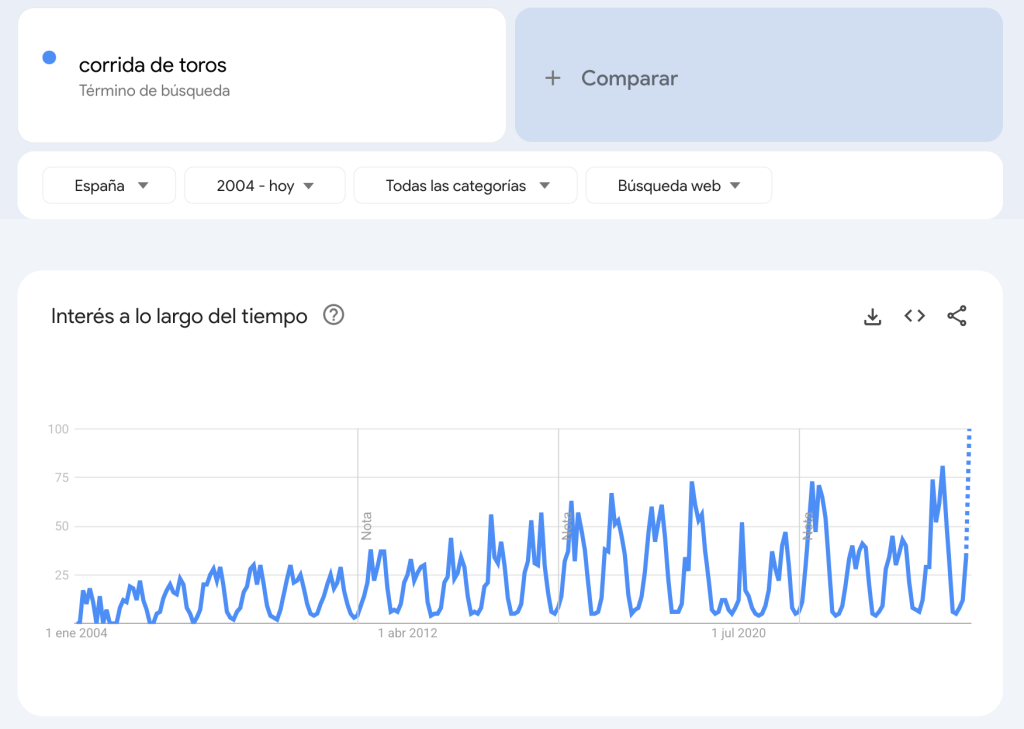
The honest picture: The government subsidizes bullfighting in Spain as protected cultural heritage — the fiesta nacional, the national festival. Catalonia banned the practice in 2010, but was overruled by the Constitutional Court in 2016. The current conservative government in Madrid has been vocally supportive of the tradition. Google Trends show a seasonal interest, and growth can likely be explained by increased internet use. Nevertheless, a recent poll found 7 out of 10 Spaniards oppose bullfighting, attendance at corridas has declined significantly over the past two decades, and the industry depends heavily on municipal subsidies to stay solvent.
At the same time: The tickets for Las Ventas during San Isidro sell out. The season in Seville is a genuine cultural event, and not a tourist performance. When a great matador has a good faena — a great performance — it makes the front page of the sports section like a soccer match. For some Spaniards, bullfighting is not a relic or an embarrassment, but a living art form, as technically demanding and aesthetically serious as anything in a concert hall or soccer pitch.
To its credit, Tardes de Soledad refuses to adjudicate between the sides. Serra doesn’t make a case for bullfighting. He also doesn’t make a case against it. He films a man who is extraordinarily good at something, in a country where some celebrate that thing, and others contest that thing. Serra lets you watch without telling you what to conclude. The animal rights protesters wanted the film to take a position. The critics who loved it loved it precisely because it didn’t.
If you want to understand Spain — not just visit, but understand — the bullfighting question is one you’ll encounter eventually. This film is a more useful guide than any op-ed or Wikipedia entry: It doesn’t pretend the question has a clean answer.
Watching Tardes de Soledad
Though I only watched the film once, the intimacy of Tardes de Soledad jumped out immediately.
The close-ups feel relentless. Serra’s camera sits so close to the action that you lose all sense of the wider spectacle — you see only bits of the crowd’s first row, the sand, and the size of the arena. What’s left feels intimidatingly close. The enormous bull suffers, while Roca Rey moves around it with a precision that is beautiful in the way that mastery of any difficult thing is beautiful. That doesn’t make me want to watch a bullfight in person. But as Palacios said during the after-film Q&A, “It makes you ask why would a young man dedicate himself to this practice? Why would someone dance with death? Why would someone put themselves between the horns of a charging bull?”
These are questions only a bullfighter can answer. But for all intents and purposes, the bull is the protagonist of this tragedy. One sequence — I won’t describe it in full — involves the final moments of a corrida that’s a tough watch. Serra’s direction makes clear he’s not being glib about the events. The bull has gravity — perhaps more than Roca Rey. Its death is not treated as incidental.
And then Roca Rey gets in a car and drives to the next city. His posse of picadors and managers and continually pump him up in those closed quarters. “That bull was this son-of-a-bitch.” “You’re a legend.” “You’re one of the best ever.” On and on.
The moment Roca Rey leaves the van, the posse flips and discusses how lucky he was that the bull headbutted him and he only got caught between the horns and not on the end of one. They never let Roca Rey see they’ve created the fable, or that he’s anything but invincible. They understand the fragile psychology between living and dying better than the star.
The hotel room scenes between fights are almost funny — assistants literally lifting the matador off the ground to get him into his impossibly tight pants, adjusting the embroidery, consulting on the cape. There’s something absurd, and yet moving, about the care that goes into dressing a man in sequined suit so he can go kill a 2,000-pound animal with a sword. The tardes de soledad of the title — “afternoons of solitude” — is reportedly a phrase Roca Rey uses for the hours before a corrida. Just him in a hotel room, in a city that could be anywhere, waiting for the afternoon.
Serra, to his credit, never makes you feel like you’re being handled. He’s not building to a revelation. He’s not going to cut to an interview at the end where someone explains what you just watched. You saw what you saw. What you do with it is up to you.
Should tourists go to a bullfight in Spain?
Here’s where I’ve landed: It depends on what you’re looking for and what you’re able to sit with. For most people, I’d say no.
If you’re going as a cultural experience to understand Spanish identity, in the same way that you might go to a flamenco show or a football match, then the most historically significant venues are the Plaza de la Maestranza in Seville, which has been operating since 1765, and the Plaza de Toros de Ronda, which is the oldest bullring in Spain and worth visiting for the architecture alone even on a day when there’s no corrida.
If animal welfare is a firm position for you — and it’s a reasonable one — then there’s nothing casual or appealing about what happens. The bull dies a slow and torturous death. Every time. Tardes de Soledad will not let you forget that, and neither will the real thing.
A middle path: The Museo Taurino in most major Spanish cities gives you the history, the art and the cultural context without the event itself. The one in Seville, adjacent to the Maestranza, is terrific.
The film, in the end
Tardes de Soledad won every award it was eligible for and divided almost nobody who watched it, which is unusual for a film about such a divisive subject. The last documentary I watched and felt that way about was Get Me Roger Stone, a film about the Republican political operative who helped get Donald Trump elected in 2016. Viewers on the political left thought Stone was a scumbag. Viewers on the political right thought he was just clever. Most agreed it was a great film, and the director didn’t take a position.
To me, Tardes de Soledad is a film about ritual and loneliness and the peculiarity of being great at something that the world can’t agree on. Those themes reach past the corrida into something more universal. Tardes de Soledad captures a tradition the country can’t quite bring itself to either defend or abandon, and does so with rigorous attention that bullfighting deserves and that the debate around it almost never gets.
Tardes de Soledad is streaming now on MUBI. Runtime: 124 minutes. In Spanish with English subtitles.