
Let’s get it out of the way: Iberico cheese, or queso ibérico, isn’t the most popular cheese from Spain. That title goes to queso manchego. It’s also not the most expensive cheese in the world, nor the best cheese in the world — both of which are Spanish, by the way.
Queso ibérico still has plenty going for it, however. In fact, it might be my favorite Spanish cheese, as it’s versatile, it’s affordable, and of course, it’s delicious. If you’ve spotted it at Trader Joe’s or your local specialty grocer and wondered whether it’s worth picking up, the answer is yes.
Table of Contents
What is queso iberico?
Queso ibérico is a firm, slightly oily cheese that comes from La Mancha, Spain. The cheese derives its name from the demonym for the Iberian Peninsula: ibérico means “Iberian” in Spanish, referring to the peninsula that Spain and Portugal share.
Ibérico’s milk gives it distinctive character. While most well-known cheeses draw from a single animal, queso ibérico uses a blend of cow’s milk, sheep’s milk, and goat’s milk. Each contributes something different to the final flavor — and together they produce a cheese that’s more complex than its modest price tag suggests.
Unlike queso manchego (and a number of terrific cheeses), Culinaria Spain doesn’t offer an entry on queso iberico, which is curious — 25 different varieties appear in the section dedicated to Spanish cheeses. There’s also no Wikipedia entry for queso ibérico, which is surprising, too! The article on queso manchego in English only makes a faint mention of queso ibérico.
What does queso iberico taste like?
The three-milk blend gives queso ibérico a surprisingly layered flavor
profile:
- Goat’s milk contributes a subtle barnyard tang that keeps things interesting
- Cow’s milk brings a mild acidity and creamy base
- Sheep’s milk adds a rich, buttery depth
The result is a cheese that’s mild enough to appeal to nearly everyone but complex enough to reward attention. It’s firm and slightly waxy, with a smooth texture that slices cleanly and melts evenly. The flavor is nutty, a little salty, and gently oily — never sharp, never overwhelming.
If you’ve eaten manchego and found it a bit intense, ibérico is worth trying. It’s softer in flavor and texture, making it an easier everyday cheese.
Iberico cheese vs. manchego
Maybe you’re at a grocery store or restaurant, and you see both queso manchego and queso ibérico available. You’re not sure what the difference is between these two cheeses — well, that’s OK.
The big difference between queso manchego and queso iberico comes down to milk. While both cheeses come from La Mancha, queso manchego uses only sheep’s milk, while ibérico uses a blend of sheep’s, cow’s, and goat’s milk.
This leads to queso ibérico having a softer consistency and a milder, oily, nutty flavor. Manchego is firmer — increasingly so as it ages, which is common. Aged mangchego transitions from the salty, smooth semicurado to the crystalline, piquant curado.
Additionally, unlike queso manchego, queso ibérico isn’t protected by the denominación de origen, or DOP, as a cheese of protected origin. The DOP system in Spain, as in other parts of Europe, is used to “recognize a differentiated quality, a consequence of its own and differential characteristics, due to the geographical environment in which the raw materials are produced, the products are manufactured, and the influence of the human factor that participates in them.”
TLDR: Queso ibérico is more of an everyday cheese and doesn’t have to follow as strict of regulations on who produces it or where and how they produce it. That doesn’t make ibérico a lesser cheese, per se — but it does make it less expensive.
This map shows all the cheeses and butters protected by Spain’s DOP system.
How to cut Iberico cheese
Chances are you didn’t buy an entire wheel of iberico cheese, but rather, a wedge. If you’re trying to figure out how to make the most of your queso ibérico, it’s simple.
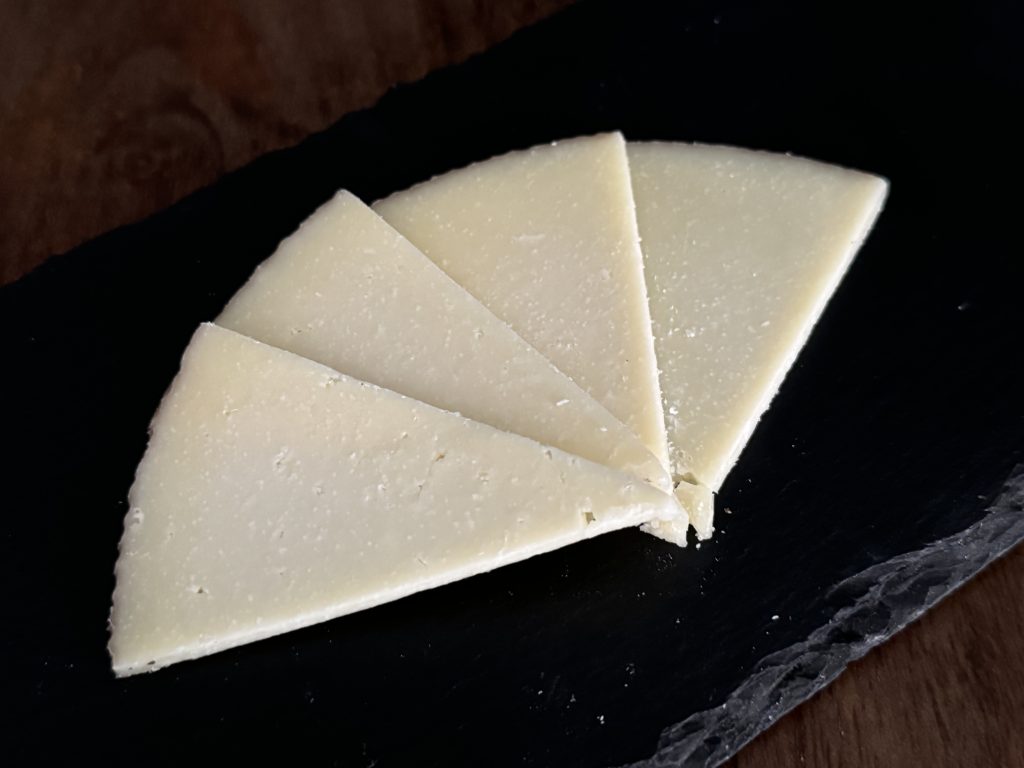
Place the wedge on one of the rectangular sides that used to be on the inside of the wheel. It’s easiest to have the rounded side facing toward you. Then place your knife parallel to the bottom of the wedge. Slice downward, about ⅛ of an inch thick, and you’ll make a little triangle that’s round on one side. Discard this first piece, as it has the wax rind on the bottom.
From there, continue cutting those same triangles about ¼ of an inch thick. You can cut off the round rind if you feel like it, but eating the rind won’t hurt you; it’s just wax.
Is the rind on queso iberico edible?
While the rind is edible, that doesn’t mean you should eat it. Lots of cheeses will have a thin paraffin wax rind to simulate traditional cheese rinds. Eating the rind won’t hurt you, but it also won’t taste great. I cut off the top and bottom rind of queso ibérico, but leave the round part when I cut triangles. Whether I nibble on the slice or use it on something, I don’t like to waste extra cheese to avoid a small amount of rind.