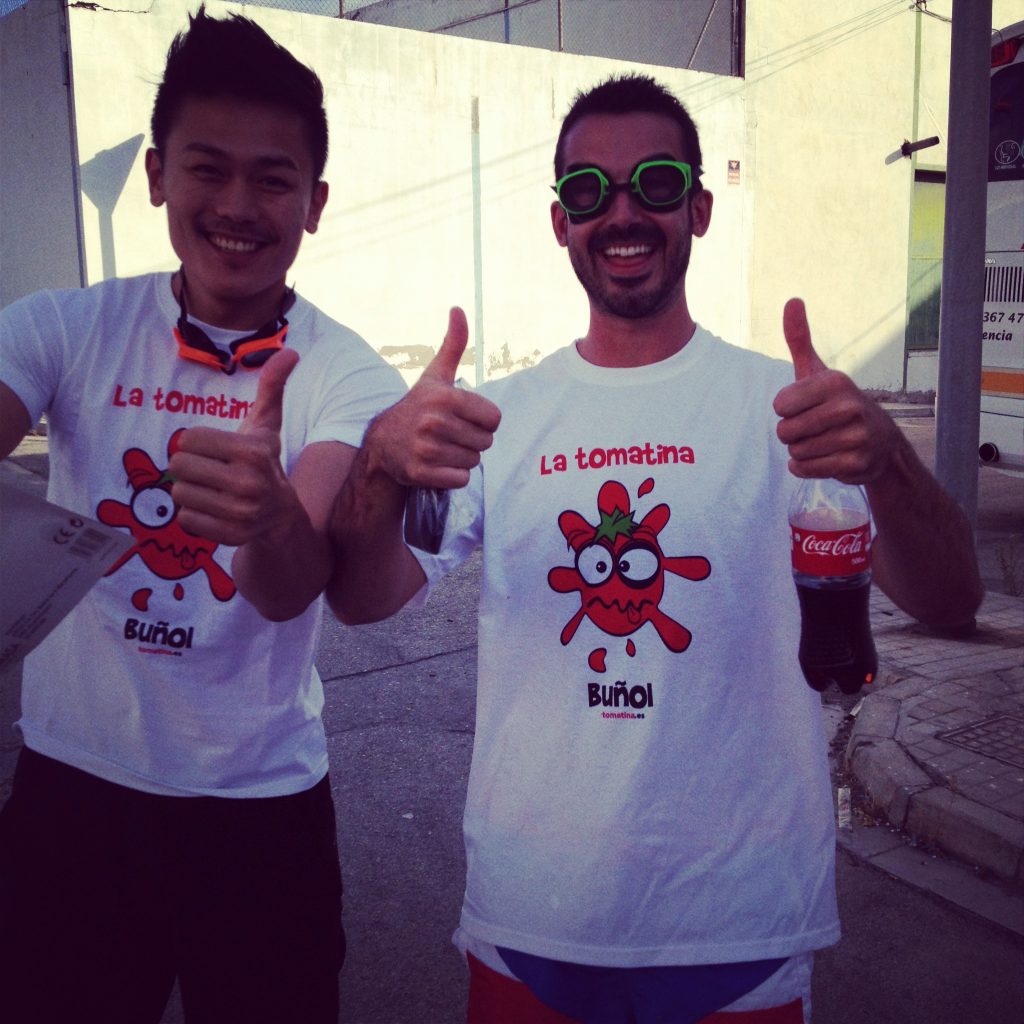
Way back in 2012, I attended La Tomatina on a whim. I couldn’t tell you the other guy’s name from this photo; only that he was a Japanese tourist on the same bus as me from Madrid to Buñol and back, and the photographer was a Canadian guy named Ogene. Ogene was from Saskatchewan, and I sat next to him on the bus. He was kind enough to share the bottle of rum he’d brought aboard, and that bottle of Coca-Cola in my hand was about 1/3 full of rum.
I can definitively say this about La Tomatina: It was one of the most unique and fun events I’ve ever attended, and I’m glad I went. Would I do it again? Maybe! I feel the same way about skydiving. I enjoyed it, but I’d die happy if I did it only once. In comparison, I’ve never attended the Running of the Bulls, and feel pretty good about that. The risk of getting a horn up my ass seems…not worth it? Getting hit with a tomato in the face is a lot more palatable.
Table of Contents
I’ll explain the basics on La Tomatina and fill in what my experience was like way back when.
What is La Tomatina?
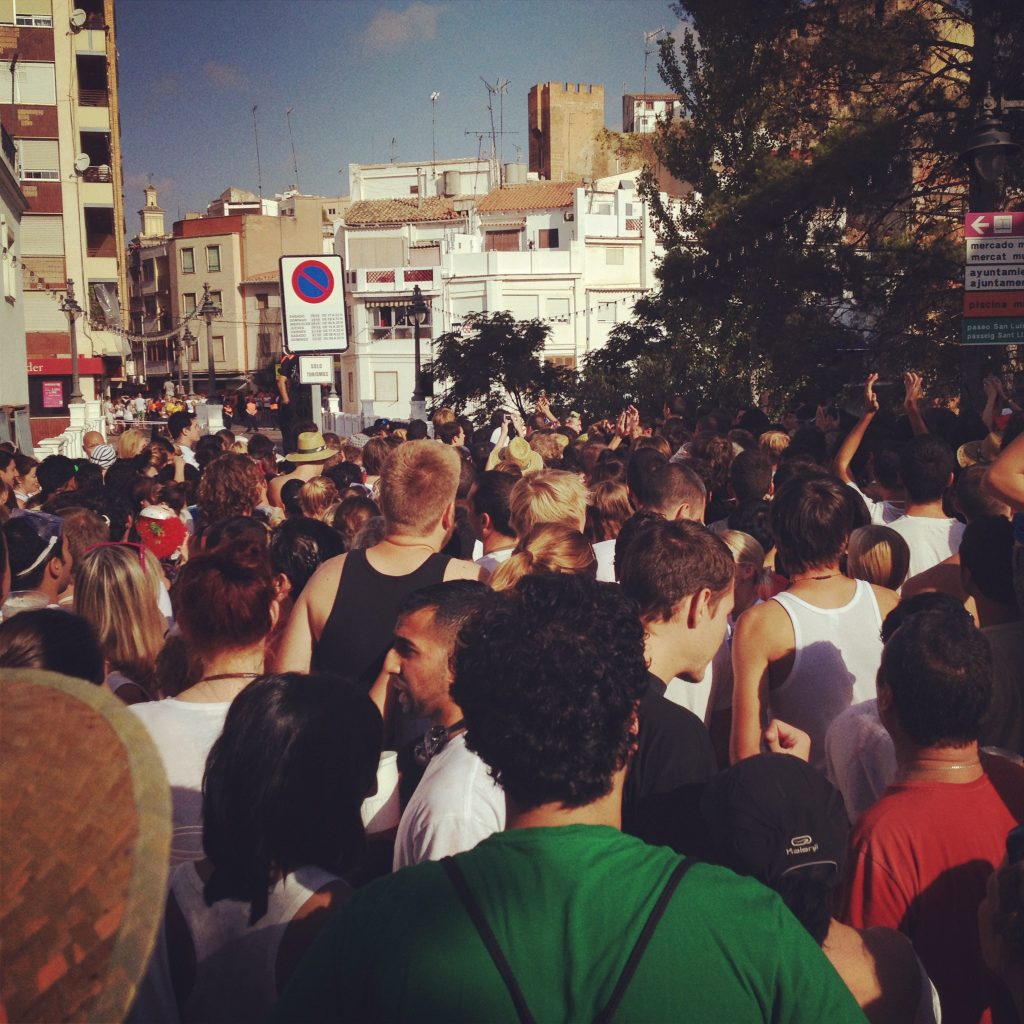
La Tomatina is an annual festival capped off by a gigantic food fight in Buñol, Spain. The town is picturesque, but otherwise nondescript, with about 9,000 residents. On the big day, however, the festival attracts 20,000 visitors — it used to draw 40,000, but since 2013, the event has required tickets to control crowd sizes. La Tomatina isn’t just any food fight, either — it’s a tomato battle with distinct rules of engagement.
When officials give the signal, revelers start squishing and throwing tomatoes at one another with impunity. It’s like being in the center of a tomato tornado. This goes on for an hour until the streets run red with tomato pulp. Squishing the tomato is a courtesy to your indiscriminate targets, as otherwise, it’s like being pelted with a baseball (with some obvious give). You’re trying to smear strangers; not give them a black eye.
When is La Tomatina?
The festival takes place the last Wednesday of August. In 2024, La Tomatina takes place on Wednesday, Aug. 28 at noon. It’s in the same place as always, in Buñol, Spain, about 40 minutes west of Valencia.
Why is La Tomatina celebrated?
According to local lore, La Tomatina started as an altercation in the Plaza del Pueblo during the “gigantes y cabezudos” (giants and big heads) festival in 1945. A few raucous young men knocked the head off of one of the people in the parade, and that guy was so enraged, he grabbed tomatoes from a nearby vendor and started pelting the transgressors. This devolved into a food fight, and officials eventually had to break things up.
The following year, people brought their own tomatoes. In subsequent years, officials banned La Tomatina, but that didn’t stop people from throwing tomatoes — some were arrested. Then, in 1957, protesters carried a coffin around town with a huge tomato in it as a tomato burial ceremony. Starting in 1959, La Tomatina was reinstated, and since 2002, it has been recognized as a festival of International Tourist Interest by the Secretary General of Tourism.
How many tomatoes are used in La Tomatina?
According to Antena3, roughly 150,000 tons of tomatoes become vegetable artillery every year at La Tomatina. It takes six flatbed trucks to haul all of those fruits into the center of town, and when they drop their payload, all hell breaks loose.
La Tomatina festival details
The day begins at 10 a.m. when “El palo jabón” begins. This involves a ham leg up on a greased pole near the square near a church. Failed attempts and plenty of laughs ensue, and most people are drinking in the streets despite it being early morning.
At 11 a.m., after palo jabón, flatbed trucks bring in the tomatoes. People start filing in around the trucks to get a good spot with easy access to their fruity projectiles. Once noon hits, the hosts fire a bottle rocket to signal the beginning of the fight. Then pandemonium ensues.
Revelers start squishing and throwing tomatoes at one another with impunity. It’s like being in the center of a tomato tornado. This goes on for several minutes until the streets run red with tomato pulp. Squishing the tomato is a courtesy to your indiscriminate targets, as otherwise, it’s like being pelted with a baseball (with some obvious give). You’re trying to smear strangers; not give them a black eye.
This goes on for an hour, at which point another bottle rocket signals the end of the food fight. Some head to a nearby pool to wash off, and some wait in the center for the trucks to return and hose everyone down. Locals also spray revelers with their garden hoses, so you don’t really have to worry about washing off.
Rules of La Tomatina
Organizers of La Tomatina publish clear guidelines to make the festival enjoyable for everyone.
- Don’t bring bottles or hard objects
- Don’t tear or throw your clothes or others’ clothes
- Squash the tomatoes before throwing them
- Keep a safe distance from the trucks
- Stop throwing tomatoes when you hear the second warning shot
- Follow security staff directions
The idea here is to have a fun food fight; not to conquer the spirit of others by vanquishing their physical beings with in-tact tomatoes. You want to pelt people and not give them black eyes and bruises.
My experience at La Tomatina
I’d been visiting Madrid for the first time since I lived there after college, and was coincidentally there the week of La Tomatina. I’d considered going to La Tomatina, but Madrid is about 4 hours from Buñol, and I had to figure out logistics. Plenty of companies offered roundtrip buses to the event, but again, it wasn’t the purpose of my trip.
Then I went out Tuesday night for drinks with a few friends, and my friend’s husband, a Madrileño named Luís, told me I had to go if I had the chance. He repeated more than once that I should go, so I left the bar that night convinced I should.
When I got back to my rented room around 11 p.m., I looked up tickets to La Tomatina online. I found a company offering roundtrip bus fare, but for whatever reason, the site wouldn’t accept my debit or credit card. I tried calling the company, but the call went to voicemail. I went to bed around midnight, figuring I’d go some other time.
Somewhere around 2 a.m., I got a phone call on my Vodafone burner. It was the tour company, and a guy told me if I went to Plaza de Cibeles at 4 a.m., I could pay in cash and take the bus.
You can figure out what happened next.
The bus to La Tomatina
When I boarded the bus, I sat next to a guy named Ogene from Saskatchewan. Ogene was teaching English in Madrid at an academy and offering private classes. His family was from Iraq, and he grew up in western Canada. He was friendly, and in the spirit of choosing fun in your twenties, Ogene offered me to share the bottle of rum he’d brought on the overnight bus.
There I am, drinking rum and coke on a bus in the middle of the night with a guy I’d just met. I’d gone to bed a few hours earlier with no plans to party.
Along with the bus fare, the price of admission got each traveler a Tomatina t-shirt. I quickly donned mine, with my full outfit consisting of that shirt, my swim trunks, and a pair of white espadrilles I’d bought at El Rastro the previous Sunday. I put some cash and a credit card in my pocket, and kept my iPhone in a small Ziplock. I was pretty sure cell phone insurance didn’t cover tomato damage.
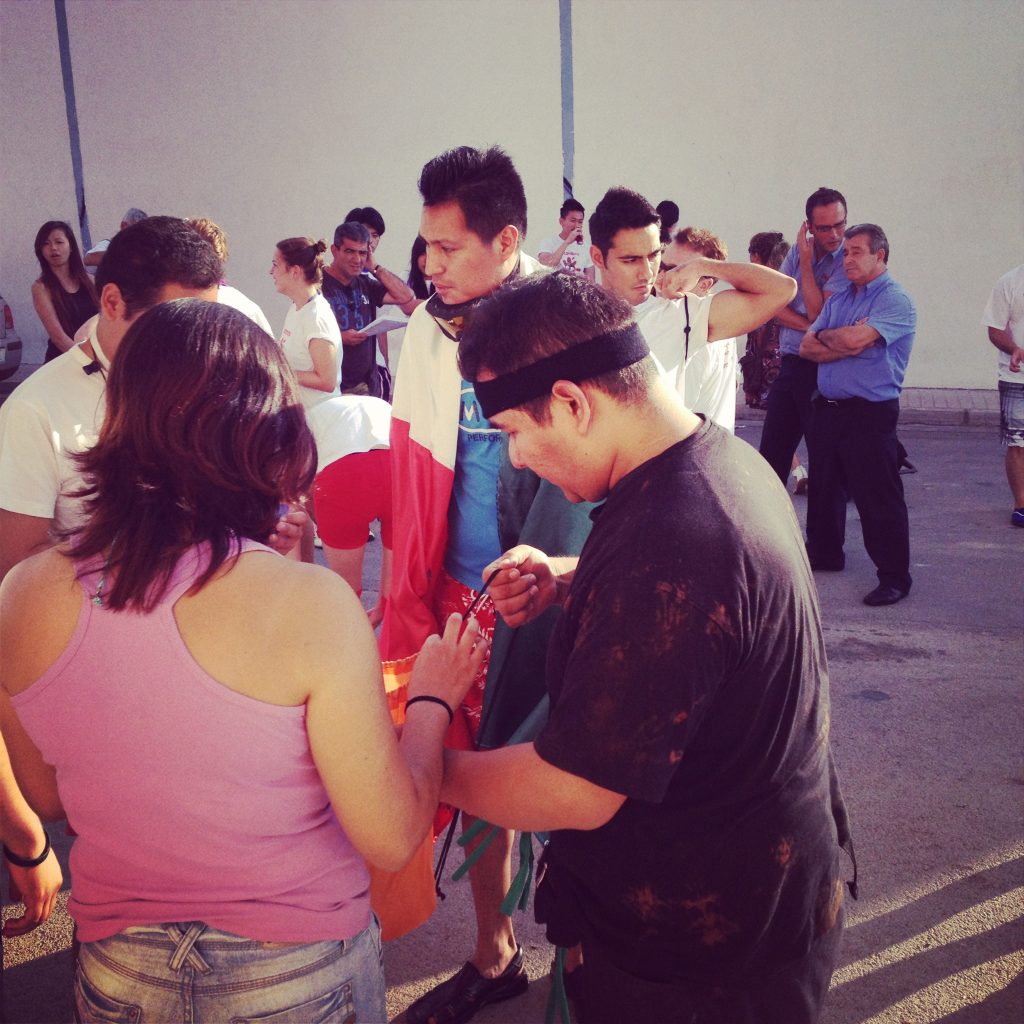
Once we got to Buñol and deboarded the bus, vendors were selling goggles around town for €2-3. I bought a pair, and it was money well spent. In hindsight, I cannot imagine participating in La Tomatina without eye protection, and for anyone planning to go, it’s worth bringing a pair.
What to bring to La Tomatina
In fact, I’d recommend not bringing much to La Tomatina, except for a few essential pieces of gear:
- Goggles
- Hiking boots/water shoes
- A small Ziplock bag for your phone or a waterproof phone holder
- A small cinch sack
From there began a long, winding walk around Buñol. The town isn’t particularly large, and the foot traffic flowed in one direction. I, like most others that morning, had a buzz going from the rum and coke I’d been swigging with Ogene in the wee hours. We passed by where the greased pole held a jamón on high, then kept about the whitewashed town until we reached its center.
I learned in posterity that my year, 2012, was the last time entrance was free; crowds had swelled to 40,000 visitors the year I went, which was four times the size of Buñol on any other day. To curb the crowds, limited ticketing brough the number to a more manageable 20,000 visitors.
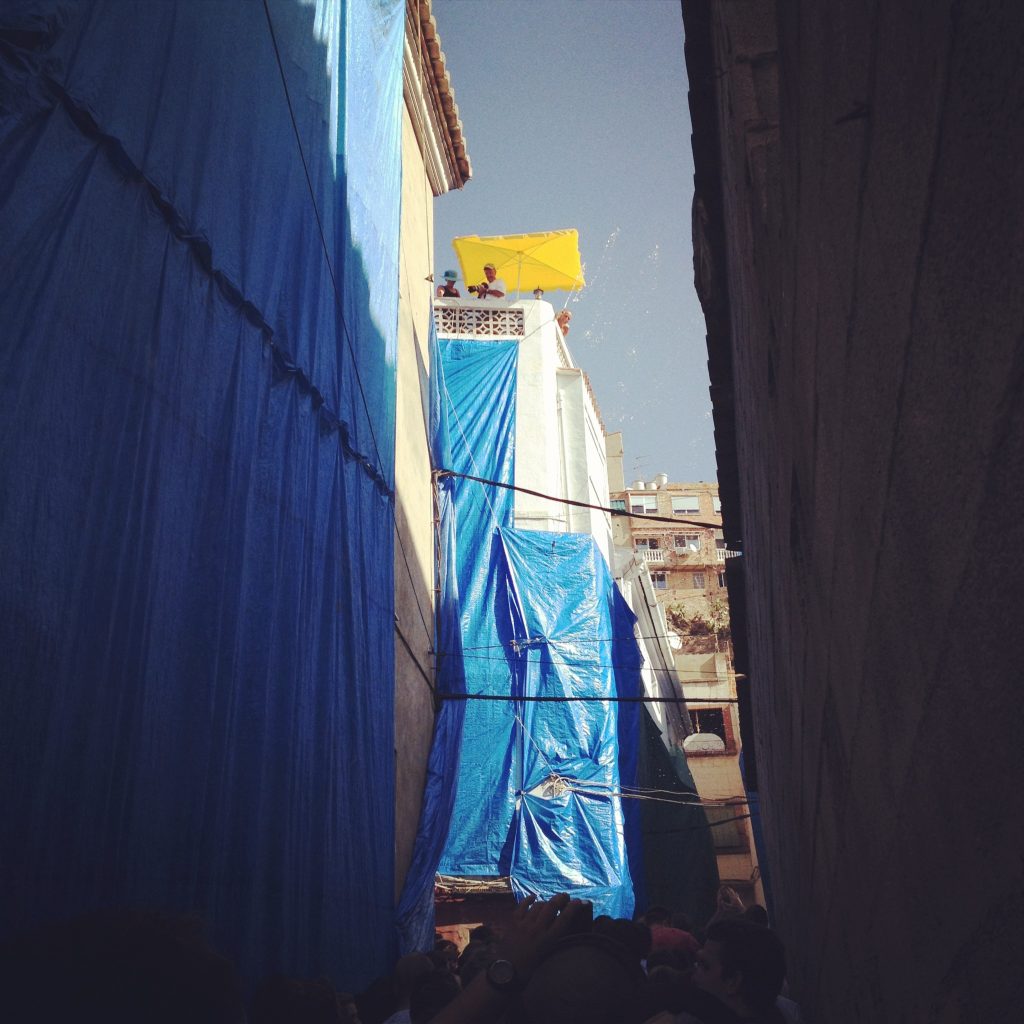
Having only a passing knowledge of the festival, I wasn’t entirely sure what to expect. The shops and many businesses around town were covered in tarps and plastic bags for protection, and locals already sprayed weak flows of water from garden hoses on their balconies. My terminus was the center of town, where I stood on the passenger flank of a flatbed truck, about four feet from its tailgate.
Aside from my alcohol buzz, a palpable current of excitement flowed through the crowd. Spain is notoriously hot in August, and this day was no different, with both the heat and the anticipation building by the minute.
Then the moment came: A first shot from what sounded like a firework, and the truck’s tailgate opened. It tilted up its bed, and with a guttural thud, a literal ton of tomatoes hit the ground.
The mad scramble for tomatoes began. I grabbed some, per protocol, and squished as I threw them indiscriminately. The most intense moment were the first few, when a red cloud hovered only a few feet over ground.
After a couple minutes, whole tomatoes had gone extinct. The street and gutter was filled with a mix of pulp and whatever sat in the street before, with everyone grabbing handfuls of slop and tossing it with abandon. It was a little more gross thinking about that as I sat there; not only were we throwing tomatoes, but the street dirt and debris, too.
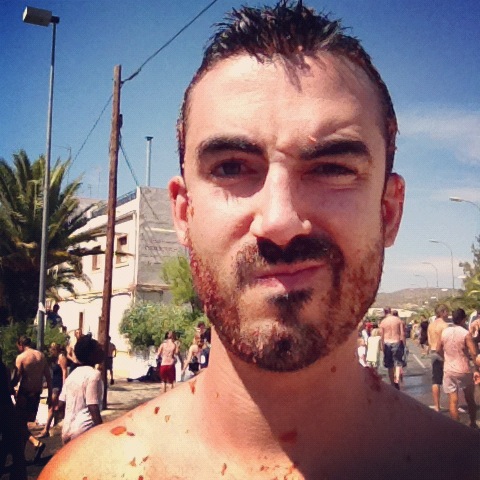
By this time, I was covered from head to toe in skin, juice and seeds. Despite my goggles, the pulp began to leak into my eyes. Of course, the moment I removed my goggles, an astute chucker drilled me with a tomato straight in the face — the most direct hit I took all day. I went from eyes stinging to ears ringing, and only after a minute of rubbing could I get my vision back to working order.
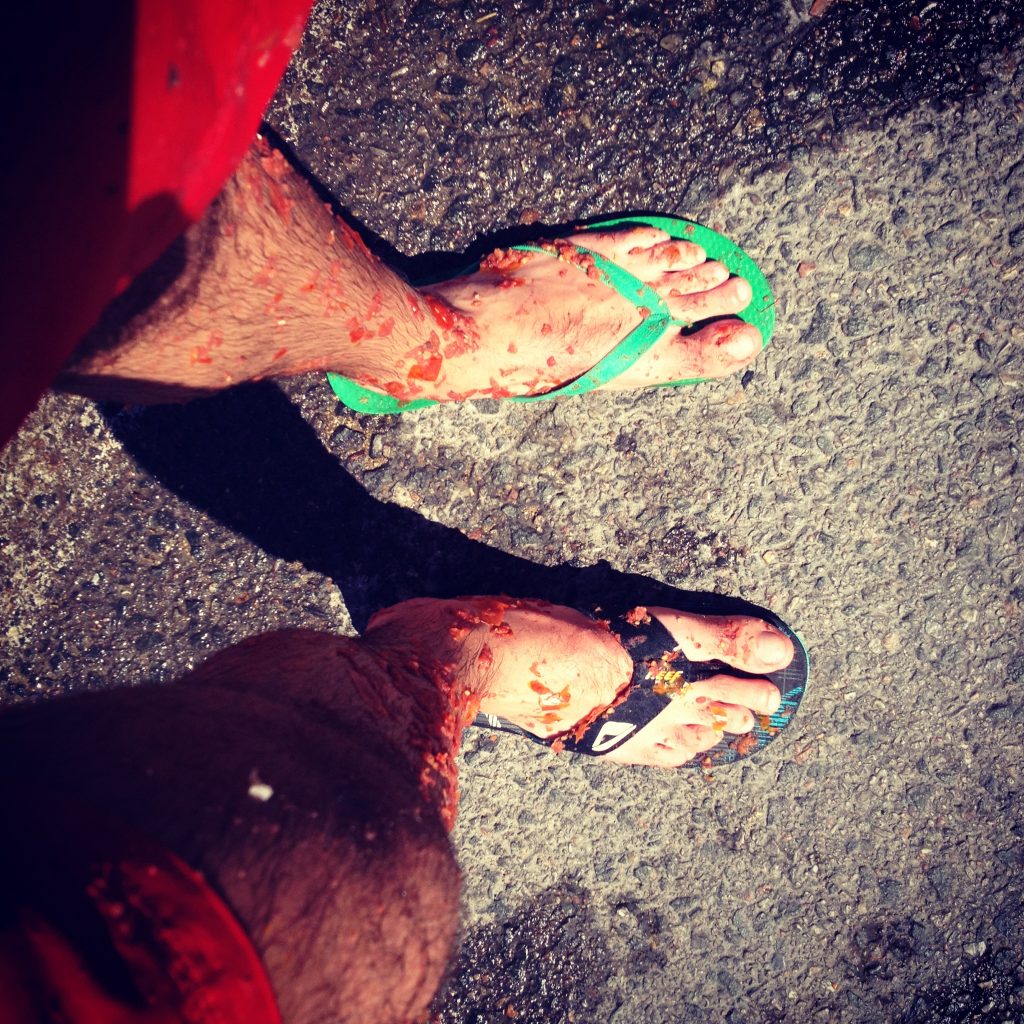
Somewhere in the melee, I realized my espadrilles were a poor choice, too; not for their white color, which was surely ruined, but because of their loose fit. As I attempted to trudge through tomato soup, the suction pulled my shoes off. Tried as I might, I couldn’t move backward through the flowing crowd well enough to spot where each went. Instead, I just reached for what was available: Someone else’s sandal. I spotted a right, and a mismatched left, and managed to keep those on the rest of the way.
R.I.P. my espadrilles. Aug. 26, 2012 — Aug. 29, 2012.
More tomatoes flowed in, and eventually, the second bottle rocket signaled the end of the show. Tomato soup filled the streets up to the sidewalk, and everyone trudged forward to leave the center. As the heat rose, locals sprayed us with their garden hoses. I managed to rinse most of the tomato out of my hair and off my face.
Back toward the bus, we were able to more properly hose off. My ramshackle outfit consisted of two mismatched flip-flops, my swim trunk, and a shirt that would never recover its color. We got something to eat, and exhausted and still picking tomato parts out of ourselves, we boardedt the bus around 3 p.m. to head back home. I dozed most of the way back, having barely slept the night before.
As a badge of courage, or perhaps just youthful, wanton nostalgia, I never bothered to wash my shirt. I tied it up in a plastic bag and allowed it to dry back in Madrid. In fact, I still have it in a plastic bag in my bedroom. I’m proud (ashamed?) to say the tomato crust remains to this day. Somehow, it didn’t smell; maybe that was the citric acid. That’s another funny thing about La Tomatina: The citric acid acts as a cleaning solvent, so by the time people hose down their homes, businesses and streets, everything looks cleaner than it did before. I couldn’t say the same, but shower back in Madrid sure felt great.
Of course, a day or two later, I fell ill with some sort of virus. I fully expected that after getting tomato-trash soup in my eyes and sleeping only two hours before an overnight bus. These were not the healthiest days of my life, but they were certainly some of the most memorable.
I regret nothing.